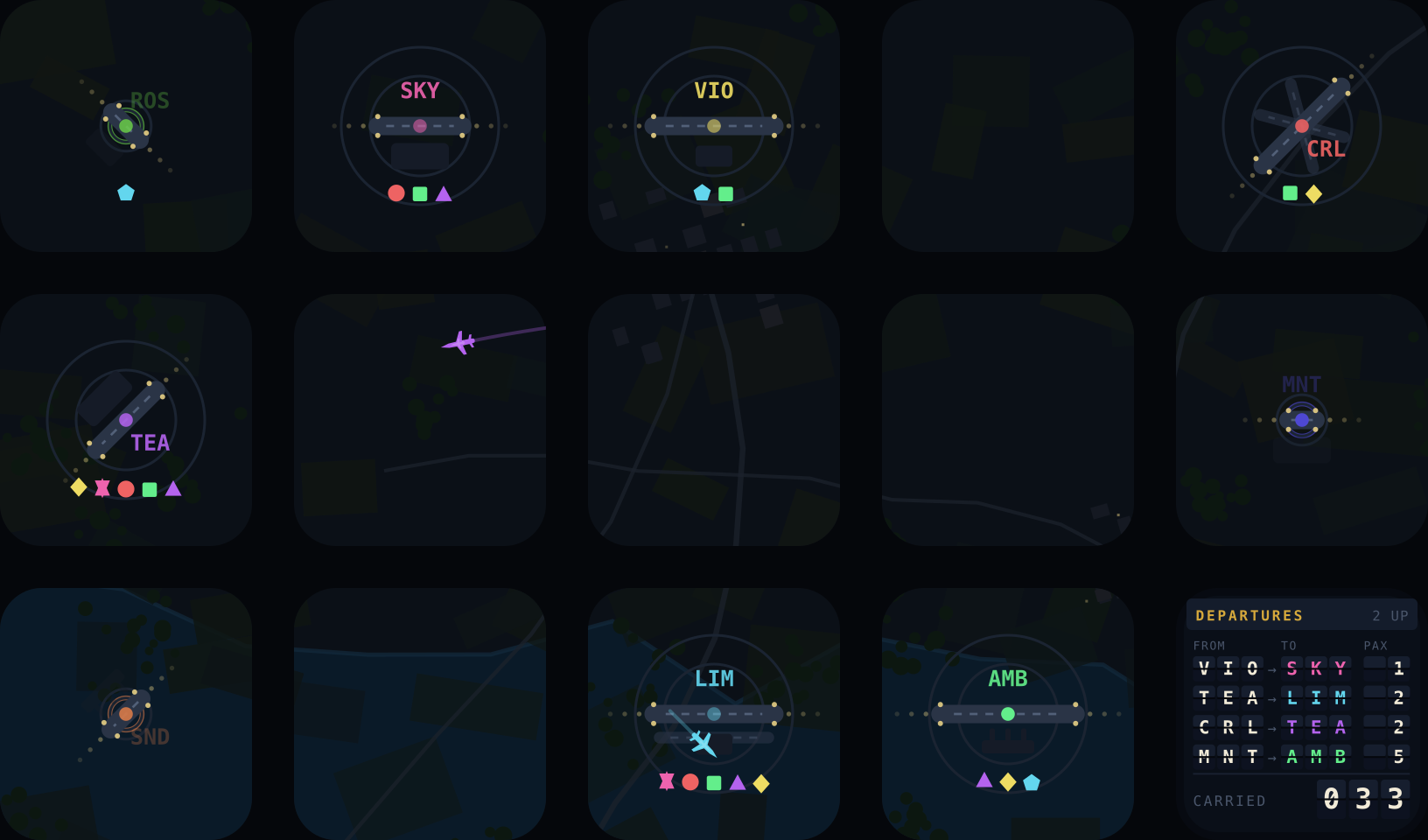
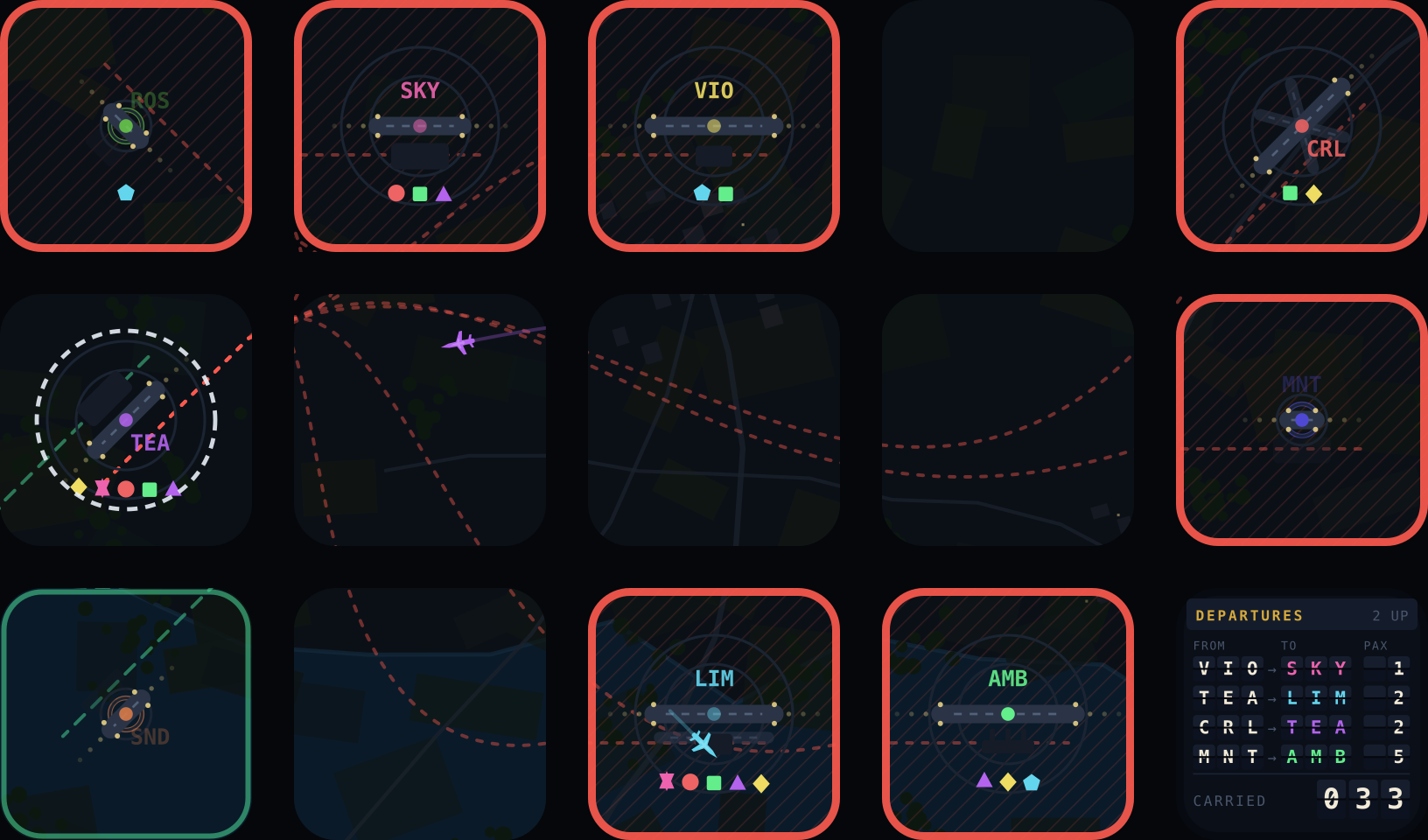
Most games on a Stream Deck are one key doing one thing. Approach uses the whole deck as a single piece of airspace: every tile is an airfield, the bezel gutters between them are real distance, and the aeroplanes you launch fly across them.
Two taps, and that is the whole game
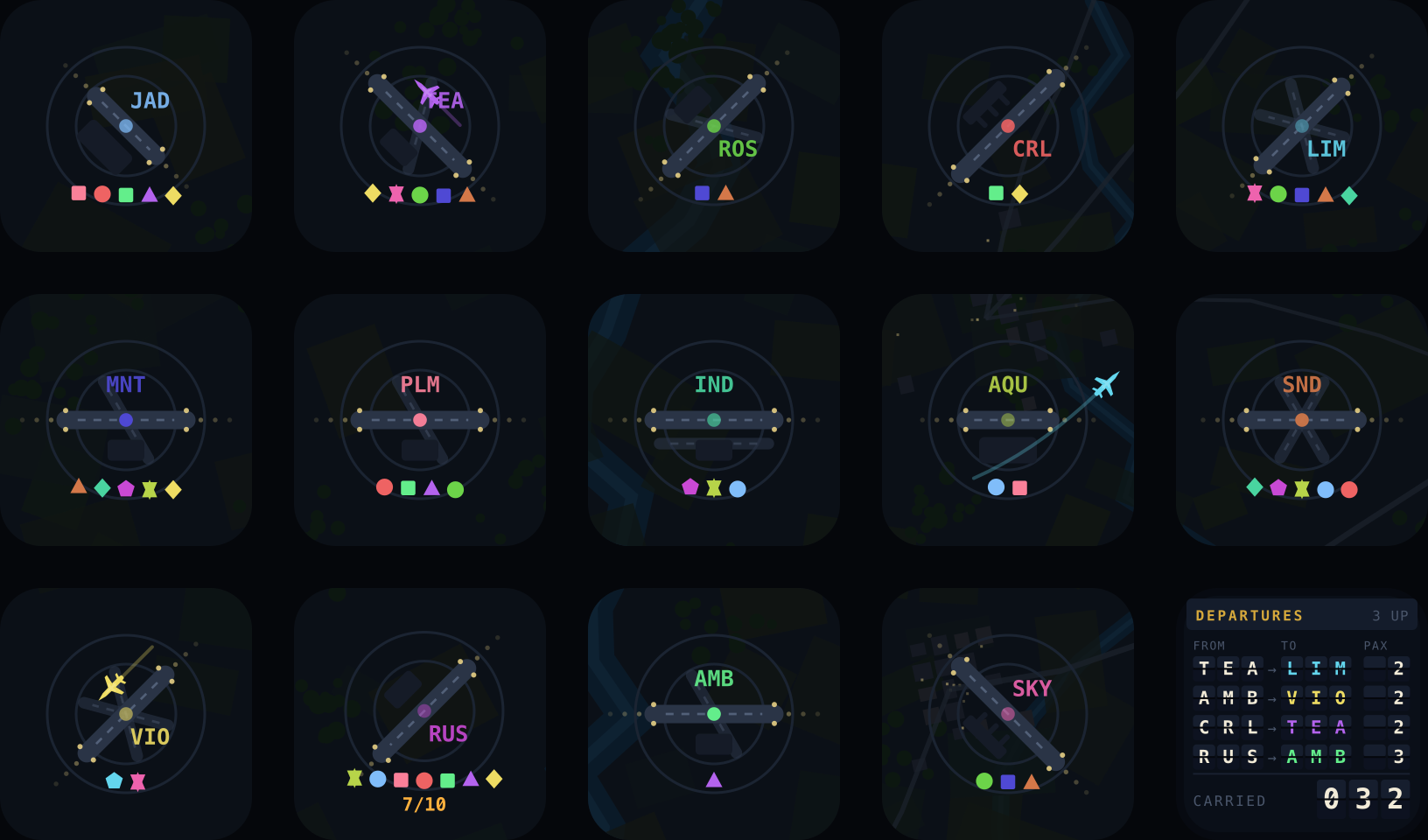
Passengers gather at each field wearing the shape and colour of where they want to go — a queue is a list of destinations rather than a number, so you can see where the pressure is building. Tap a field, then tap another, and everyone bound that way boards and flies.
The only other gesture is a hold, which clears a field of everyone at once whether or not that is where they were going. Tap empty sky to change your mind. There are no menus and no modes.
The corridor you do not fly
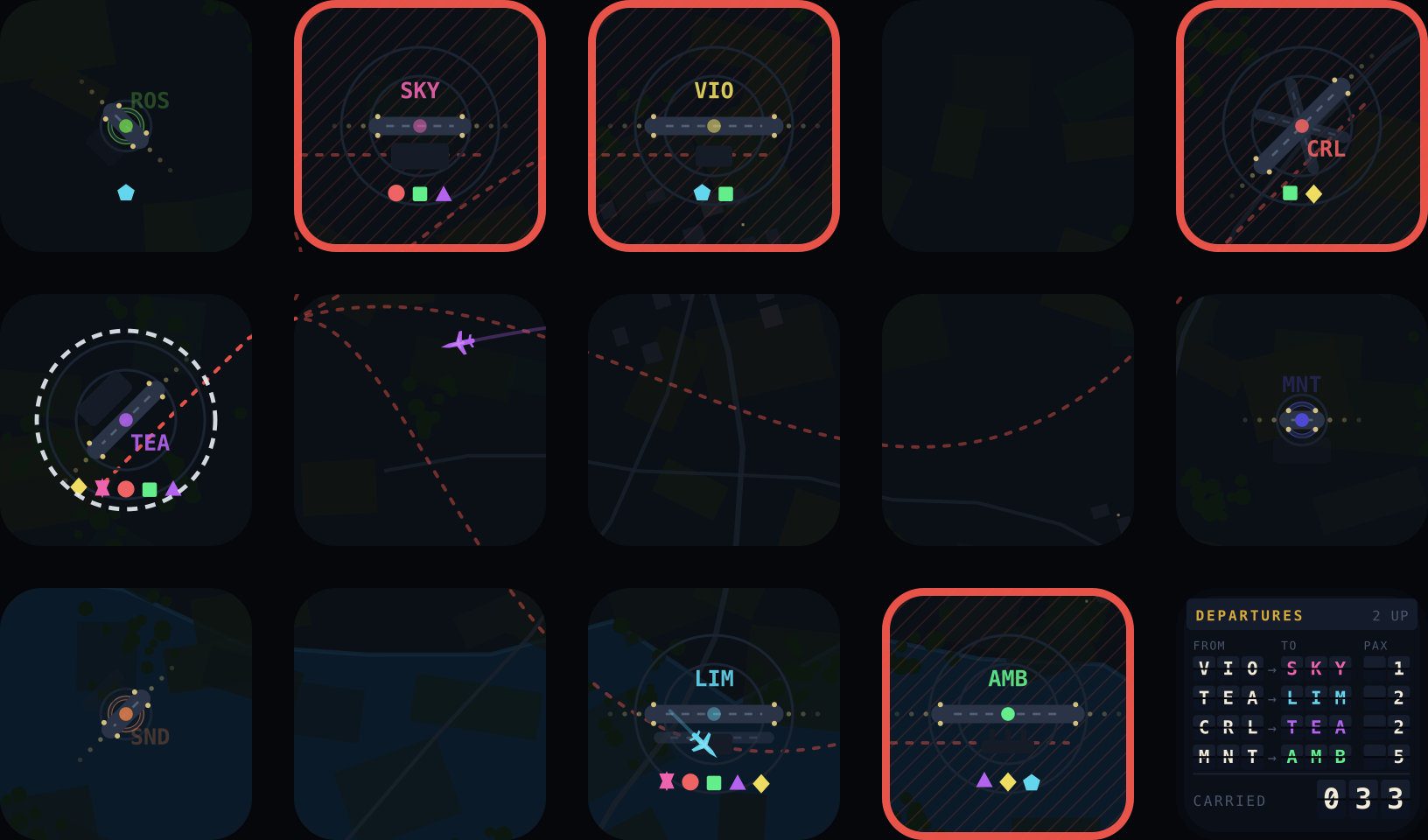
Two aeroplanes closer than the separation minimum ends the watch. So the game is not really about the route you take; it is about the one you decide against. Before you commit, the board tells you: select a field and every possible destination is marked, red where flying there would conflict.
The prediction runs the whole flight against everything already airborne, taking the closest point of approach of each pair rather than comparing where they happen to be now. A warning means two aircraft would meet in twenty seconds — not that they look close today.
Two ways to lose, and the quiet one gets you
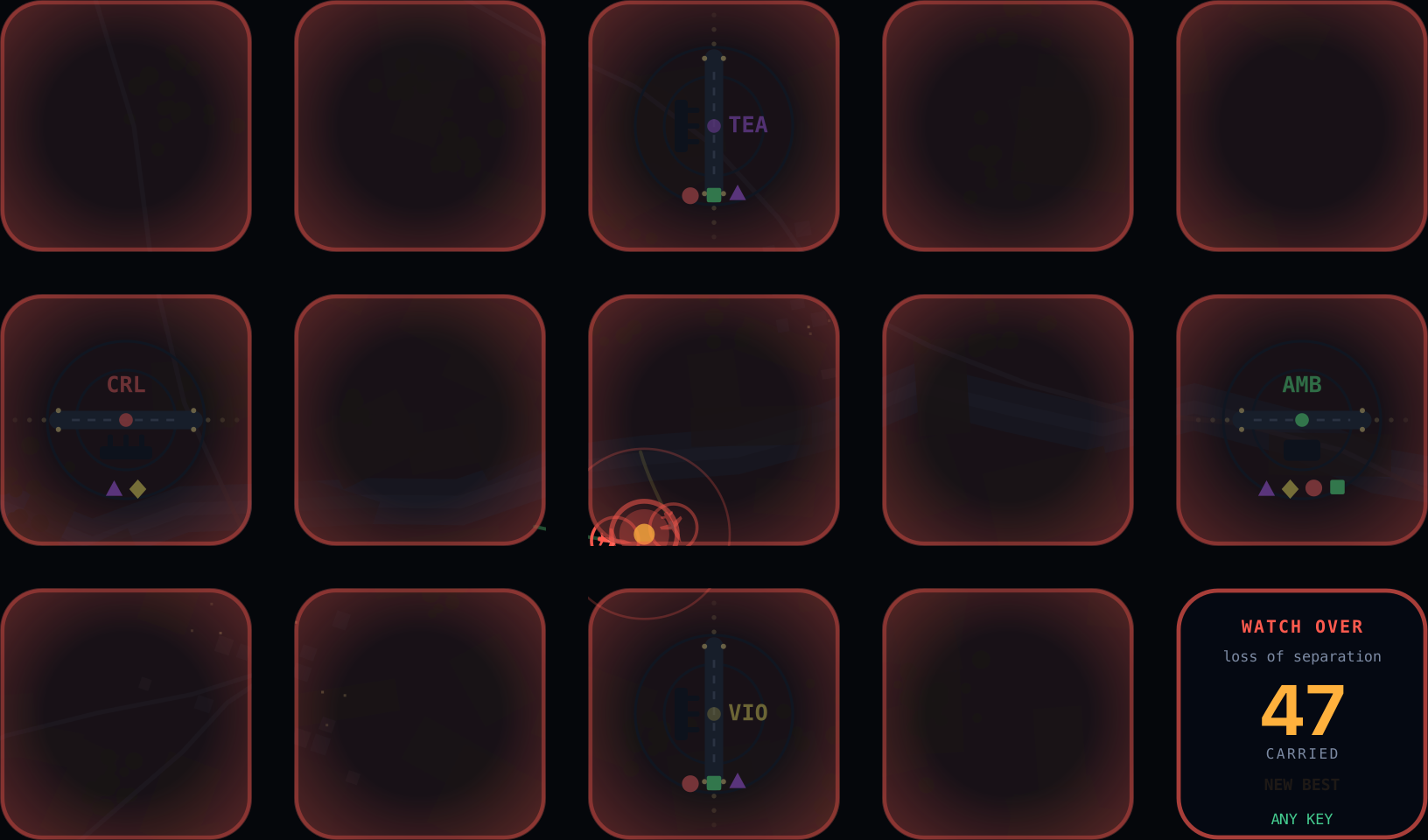
A collision is the obvious one. The other is gridlock: any field reaching ten waiting ends it too. Passengers dropped somewhere they did not ask for join that field's queue and need flying on, so a lazy clearance early becomes a cascade twenty flights later. Fields shake as they fill, and show a count once there are more waiting than you can take in at a glance.
And then the deck turns over
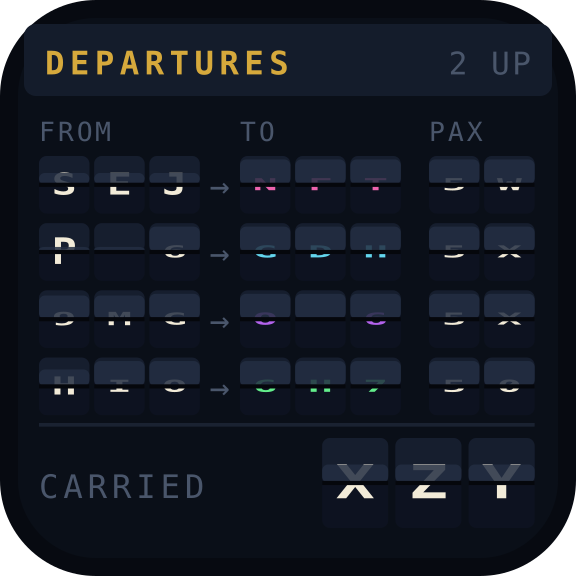
The board holds still for a moment first, with the scorch where it went wrong, because an ending you cannot see the cause of is only an interruption. Then every key stops being airspace and becomes a flap cell, and the whole deck flips over in one sweep to spell it out, with what you carried underneath in brass. It stays there until you tap.
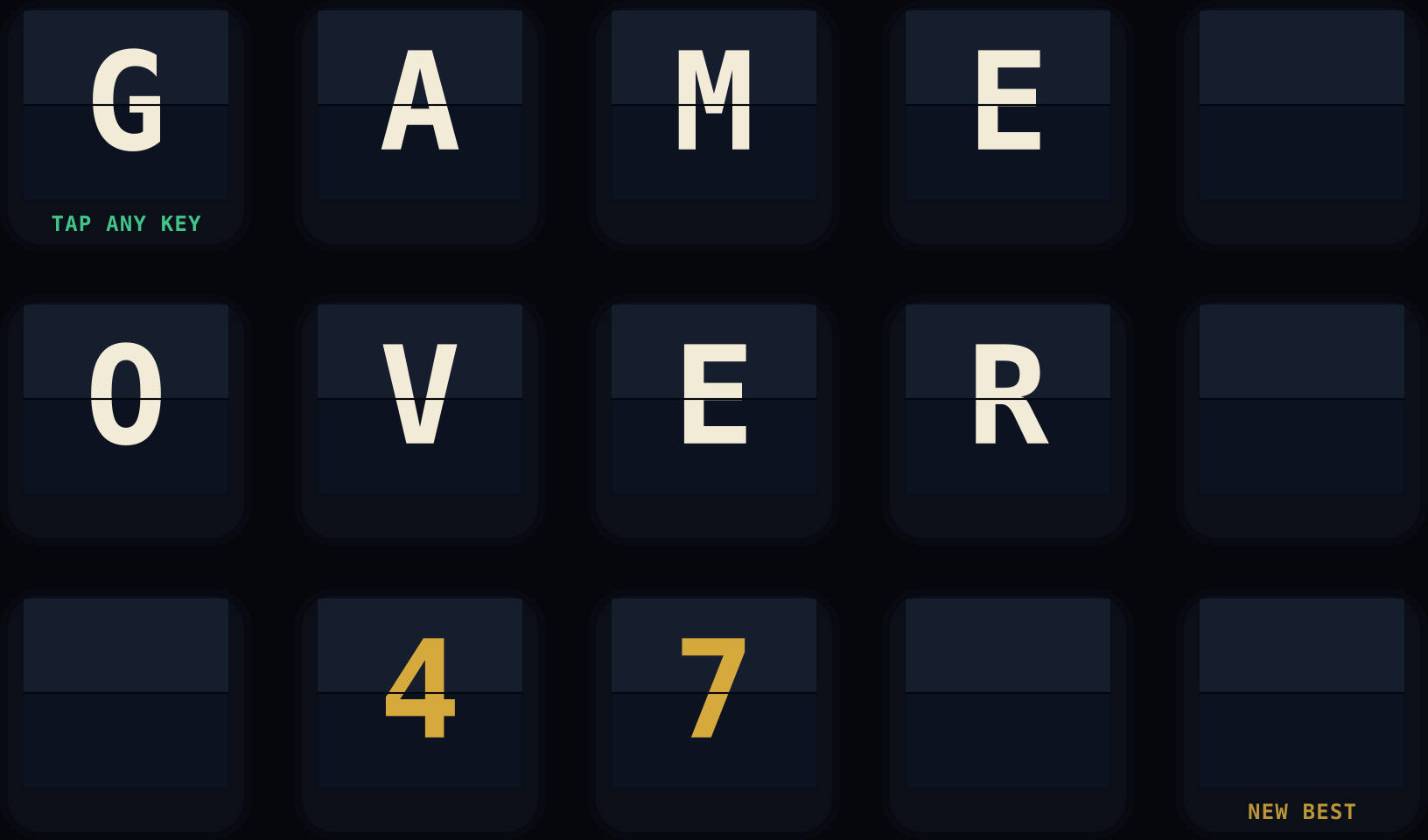
It is meant to end
Every ten passengers carried opens another airfield, and traffic builds with the board, the score and the clock. There is no winning screen. The question is how much you carried first, and your best is kept between watches.
The one key that is not airspace
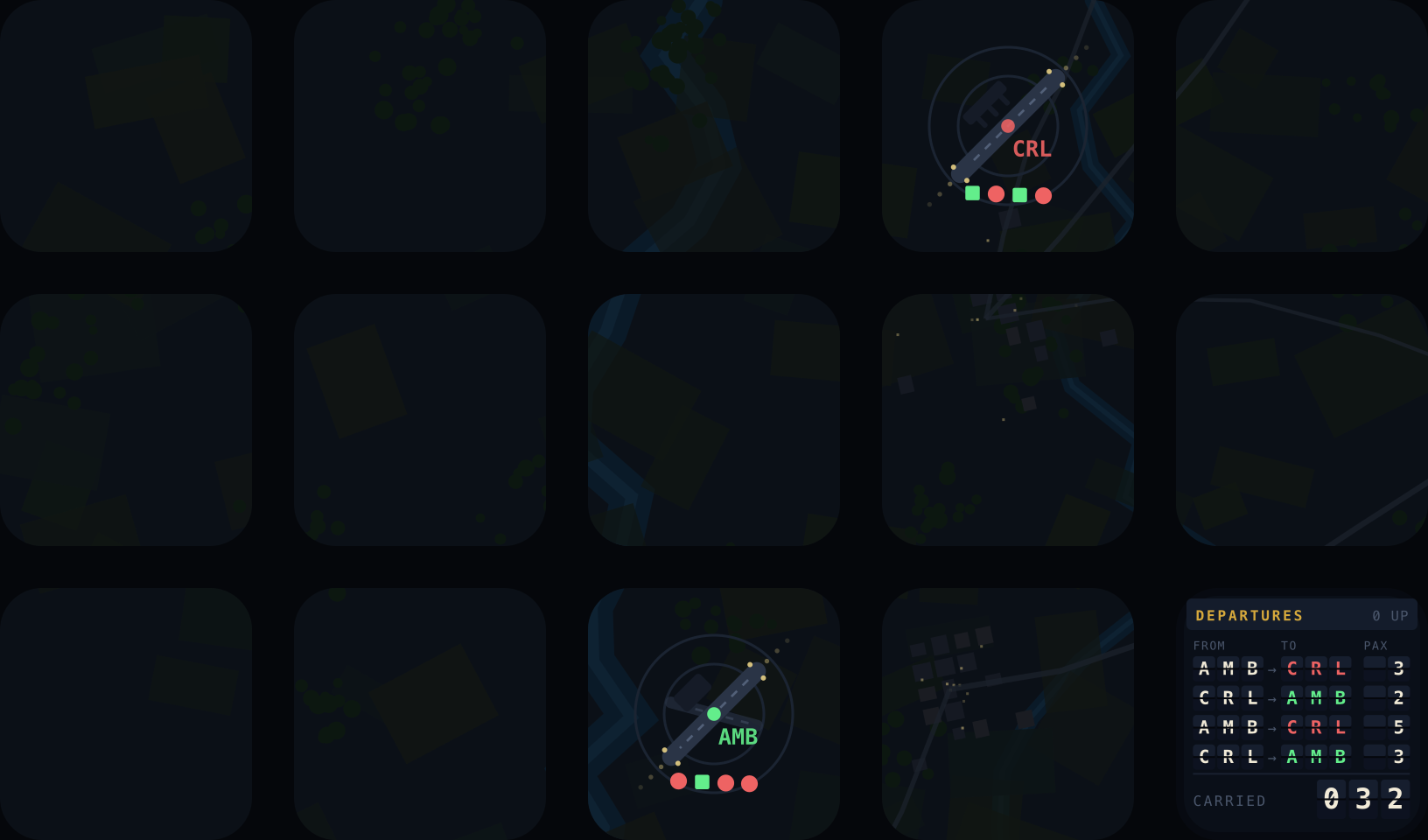
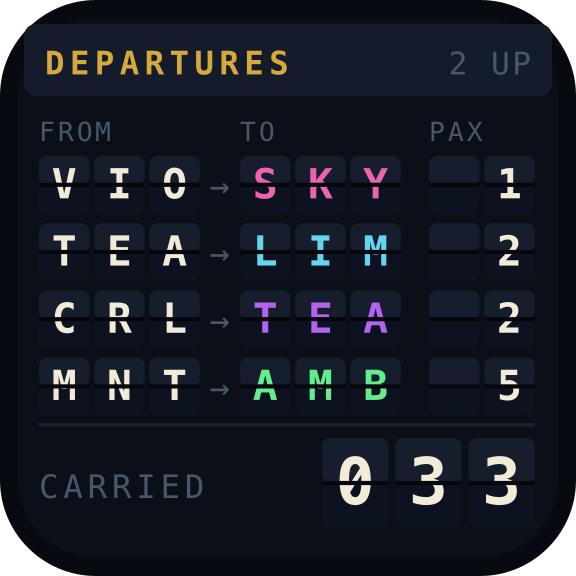
It is the terminal instead: a split-flap departures board of the kind that hung in airports before screens. Every flight you run posts a line at the top, and the whole board cascades over to make room, wheel by wheel and letter by letter, the way the mechanical ones did. The tally underneath is on wheels of its own and turns as each passenger lands.
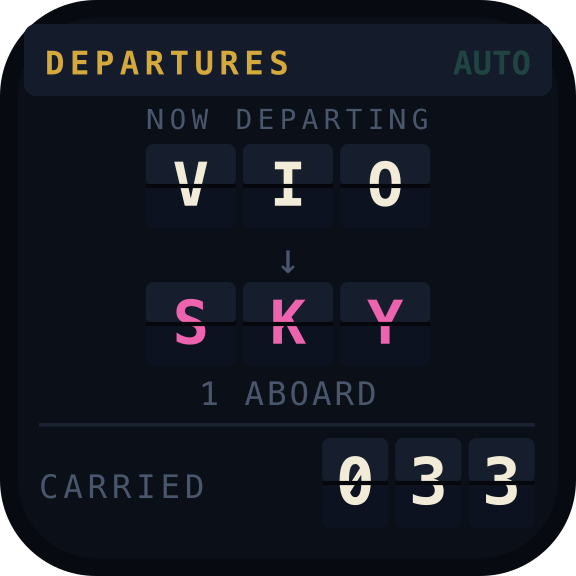
It is also the clearest possible signal that something has just left, which matters when you are watching the other end of the deck. Hold it to hand the watch over to auto mode.
A country underneath, and no two the same
Every watch generates its own patch of ground and spreads it across the whole board: farmland, woods, a river or a coastline, roads running out to the edges, and a city or two picked out in lit windows. It is drawn dark on purpose — the queues and the corridors are what you need to read — but it means no two watches are flown over the same place.
Six kinds of airfield
Single strips, parallel pairs, crossed runways, wartime triangles, hubs with finger piers, short coastal fields. Each is chosen when the field opens, so a deck of a dozen airports does not read as one aerodrome stamped a dozen times.
A breather every ten flights
Every tenth departure stands the airspace down for five seconds. Nobody new arrives, but the clock keeps running and the traffic already up carries on and lands — so it is a gap in the arrivals rather than a pause. It is usually the moment you notice the field you had been ignoring.
Or let it fly itself
Hold the departures board, or use the settings, and the watch plays itself — always choosing a corridor it has checked. It never loses to a collision; it loses to gridlock, eventually, which is a fair demonstration that clearing fields, not avoiding aeroplanes, is the real problem. Good to leave running on a spare deck.
The airspace is the keys you give it
Drop the Airspace action on two keys for a quick game or a whole deck for a long one. The board sizes itself to the block you place, one airfield per tile, with the bottom-right key given over to the departures board. Add or remove keys and a fresh watch starts at the new size.
Requirements
- Stream Deck app
- 7.1 or newer
- Devices
- Any Stream Deck with keys
- Platforms
- macOS 12+ and Windows 10+
- Keys needed
- Two at the very least; a whole deck makes the best game
It is quiet
No sound, no notifications, nothing to dismiss. A watch runs while you look at it and waits while you do not, so it can sit on the deck between other work without asking for anything.
What it doesn't do
No account, no sign-in, no network requests, no analytics. Nothing about your play leaves the machine — only your best score is kept, in Stream Deck's own settings.
Support
Something wrong, or an idea for it? Write to us and a human will answer.
Email support- •Your Stream Deck app version and operating system
- •Which device, and how many keys the airspace covers
- •What the board was doing when it went wrong
- •The plugin log from the de.7bp.approach.sdPlugin folder
Version
First release. The whole deck as one airspace, two-gesture play, corridor conflict prediction, connections, gridlock, an escalating board, a breather every ten flights, a split-flap departures board, a generated landscape and six airfield layouts, an auto mode, and a best score kept between watches.
de.7bp.approach